
Pocahontas County Criminal Court Cases
Pocahontas County criminal prosecutions are filed in the Iowa District Court within Judicial District 2B. Iowa uses one unified District Court system. It does not split local criminal work among a separate felony court and a municipal criminal court. Felonies, aggravated misdemeanors, serious misdemeanors, and simple misdemeanors all enter that state court structure. Magistrates may hear assigned simple misdemeanor matters, but the Clerk of District Court remains the local file custodian.
The clerk keeps complaints, docket entries, orders, judgments, disposition data, and sentencing records. A city police report or county booking may lead to the case, yet neither becomes the official Pocahontas County court file. Parking fines also stay outside the statewide criminal docket. Those remain with the city that issued them.
Pocahontas County Court Jurisdiction
Judicial District 2B places Pocahontas County inside a statewide court network while keeping the original case file local. The distinction explains why a search can happen from home but a document review may still require the county of filing. The public index spans Iowa trial courts. The courthouse terminal, by contrast, provides free access to public documents in the county where the case was filed.
Common criminal case codes help identify the right category. Iowa uses FE for felony, AG for aggravated misdemeanor, SR for serious misdemeanor, SM for simple misdemeanor, OW for operating while intoxicated, and AR for criminal appeal. CO and CY denote associate-court categories. The code narrows a search, but the offense description and filed documents provide the legal substance.
The Iowa Courts Online help system shows how the statewide index works.
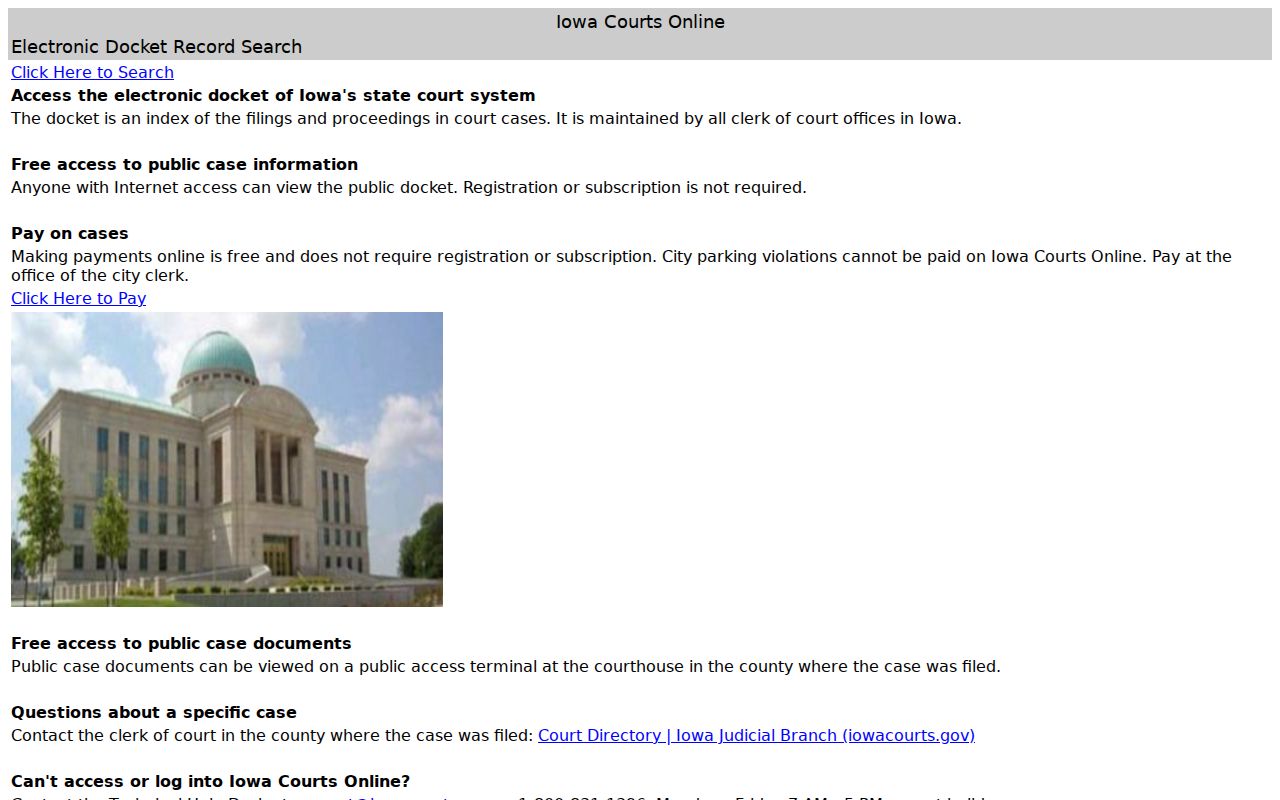
This official screen is the starting point for finding a Pocahontas County case ID before contacting the clerk or using the courthouse terminal.
Searching Pocahontas County Case Records
The free Iowa Courts Online docket search requires no account. A full case or citation number gives the narrowest result. Name searches work best when the county filter is set to Pocahontas and spelling is checked. The index generally covers public trial cases after 1998 plus some older electronic cases. Ask the clerk about pre-1998 files and any record that should exist but does not appear.
- Open Iowa Courts Online and choose the name or case/citation number path.
- Select Pocahontas County and enter the best available identifiers.
- Confirm the county, case ID, case type, party role, and filing date before relying on a match.
- Read the event history, charges, disposition, hearing data, and financial entries as separate parts of the docket.
- Call or visit the Pocahontas County clerk for public documents, certified copies, older material, or a correction to an indexed entry.
The official public docket and payment search displays the working search controls.
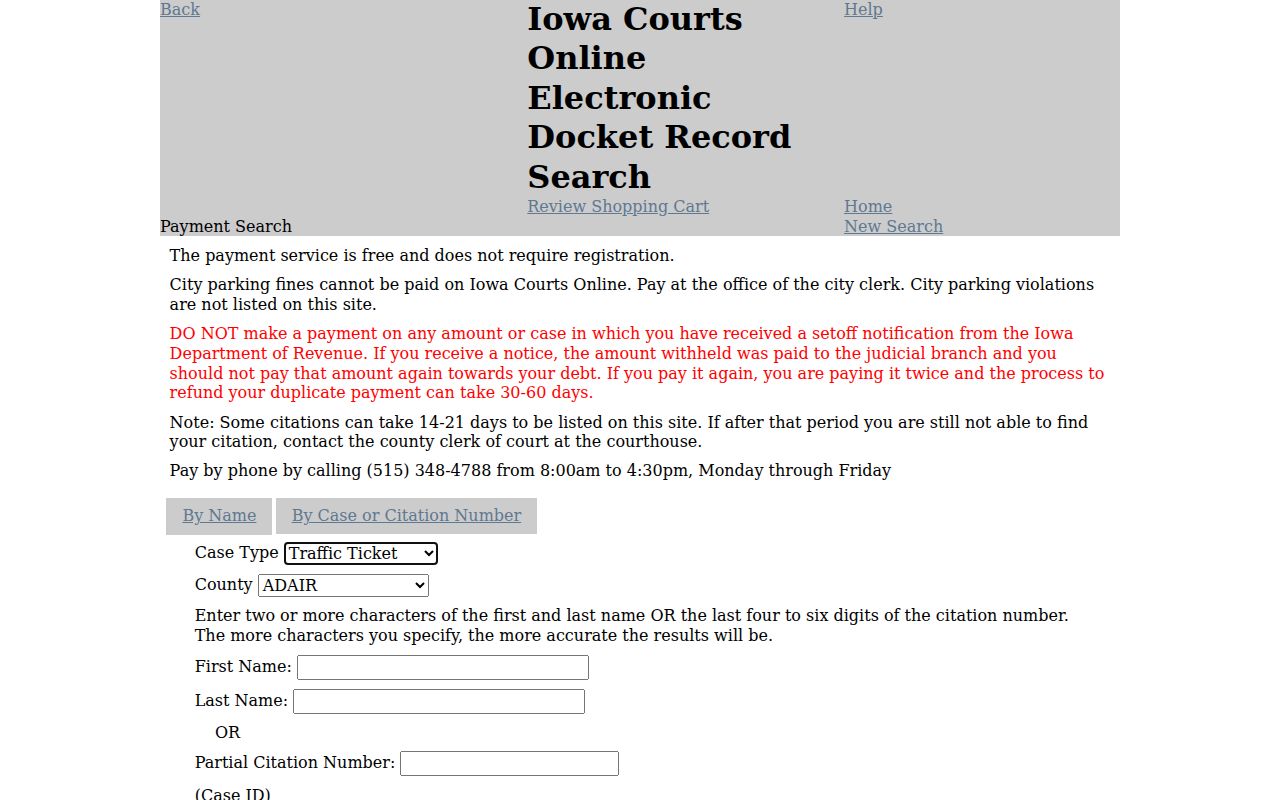
Its alternate name, case ID, and citation paths help readers avoid treating a loose name match as proof of identity.
| Field label | Type | Required | Use |
|---|---|---|---|
| By Name / By Case or Citation | Search path | Choose one | Selects the lookup method |
| County | Dropdown | Optional | Select Pocahontas to reduce common-name noise |
| First and Last Name | Text | For name path | At least two letters are needed in Last/Firm |
| Partial Citation Number | Text | Alternative | Use the last four to six digits on payment search |
| Case ID | Text | Alternative | Enter the whole 17-character ID with capital letters |
Pocahontas County Advanced Case Search
Iowa Courts Advanced Search costs $25 per month. It adds indexed details that may include more party information, liens and judgments, exhibits, service returns, full financial data, traffic data, schedules, and near-immediate clerk entries. It does not purchase online document access. The distinction is easy to miss, and it matters when the needed item is the actual complaint, order, or judgment rather than a docket label.
The Advanced Search registration page documents the subscription and account fields.
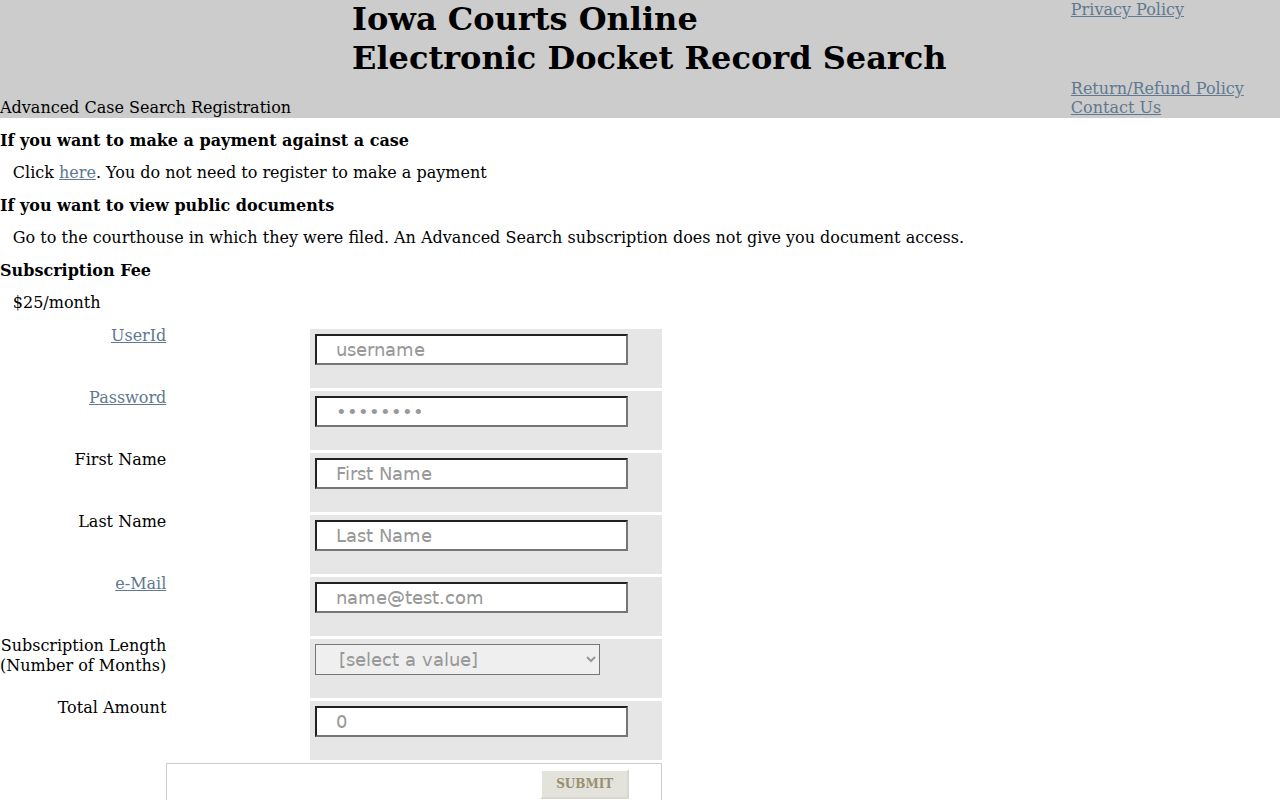
Pocahontas County users who need a filed document should still use the courthouse terminal or ask the clerk, even after buying the added index access.
Inside a Pocahontas County Case File
A criminal docket is a timeline and index. Its Summary area may show the case ID, case type, opened date, judge, and short or formal title. Party rows can identify a person's role and status. Charge and disposition rows separate the accusation from the result. Filing rows may name the event or document, filer, dates, comments, and status. Bond and financial screens can carry their own amounts, dates, and disposition fields.
| Case ID and Court | Identifies the Pocahontas County filing, court, and case type. |
|---|---|
| Charges | Shows filed offense codes and descriptions, including later amendments when entered. |
| Docket Entries | Lists filings, hearings, orders, creation dates, updates, and status labels. |
| Hearing Data | May show scheduled events and later continuance or cancellation entries. |
| Disposition and Judgment | Records dismissal, plea, verdict, or other final action when reported. |
| Sentence and Finances | Can separate sentence terms, fines, court costs, restitution, surcharges, payments, and balances. |
Not every case exposes every possible field. A docket label also does not replace the filed text. Use the public terminal or request the public document when wording, conditions, or the exact basis for an order matters.
Reading Pocahontas County Criminal Dockets
Read the record in order, but do not assume the first charge stayed in force. Start with the county and case number. Compare the initial allegation with any amended or final charge. Then follow complaint, initial appearance, arraignment, motions, hearings, plea, judgment, sentence, and later probation or revocation events. “Open,” “disposed,” and “dismissed” describe different states. None should be treated as a synonym for conviction.
Search errors often have simple causes. Remove stray spaces, type case letters in capitals, and distinguish zero from the letter O. Shorten a name when spelling varies. The official help permits a percent sign as a wildcard in some name fields. An out-of-state identification scan may even reverse first and last names. The clerk can address a suspected index error tied to a Pocahontas County file.
Bond fields should also be read apart from the charge. They may list the case or litigant, poster or agent, amount set and posted, bond type, dates, county, and a later disposition such as release or forfeiture. A bond entry concerns release security. It does not resolve guilt, and a later docket event may change the release terms.
Note: Financial entries show money activity, not the legal meaning of the case disposition.
How a Criminal Case Moves
A court case begins when a charge is filed, not merely when an arrest occurs. The county attorney decides what charge to file. The clerk then creates the docket. At arraignment, the defendant receives the charge and enters a plea under the court process. Pretrial filings may test evidence, procedure, or scheduling. A plea or trial produces a disposition, and a conviction may move to sentencing. Later entries can address payment, probation, appeal, or revocation.
Case flow: Charges Filed › Arraignment › Pretrial › Plea or Trial › Disposition › Sentencing
The court file remains independent of the booking record after release from jail. Readers tracing the earlier custody event can compare it with the separate Pocahontas County arrest lookup. A dated roster cannot answer how the prosecution ended.
Missing Pocahontas County Case Entries
The statewide payment search warns that citations may take 14 to 21 days to appear. A new court case generally appears about one business day after clerk entry, then updates in real time. When a citation remains missing beyond the posted window, contact the Pocahontas County clerk rather than starting a second, less precise name search. The clerk is at 99 Court Square, Pocahontas, Iowa 50574, and the local number is 712-335-4208.
Older nonelectronic records, juvenile matters, sealed cases, and other confidential files may not appear at all. The Judicial Branch help desk, 1-800-831-1396, handles system questions on weekdays from 7:00 a.m. to 5:00 p.m., except holidays. Case-specific record questions stay with the clerk.
Pocahontas County Federal Court Cases
Federal prosecutions arising in Pocahontas County do not appear in Iowa Courts Online. The county lies within the U.S. District Court for the Northern District of Iowa. That court maintains the federal judicial layer, while PACER supplies nationwide federal docket and document access under its own registration and fee rules.
The Northern District of Iowa is the authoritative court source for local federal filing and clerk information.
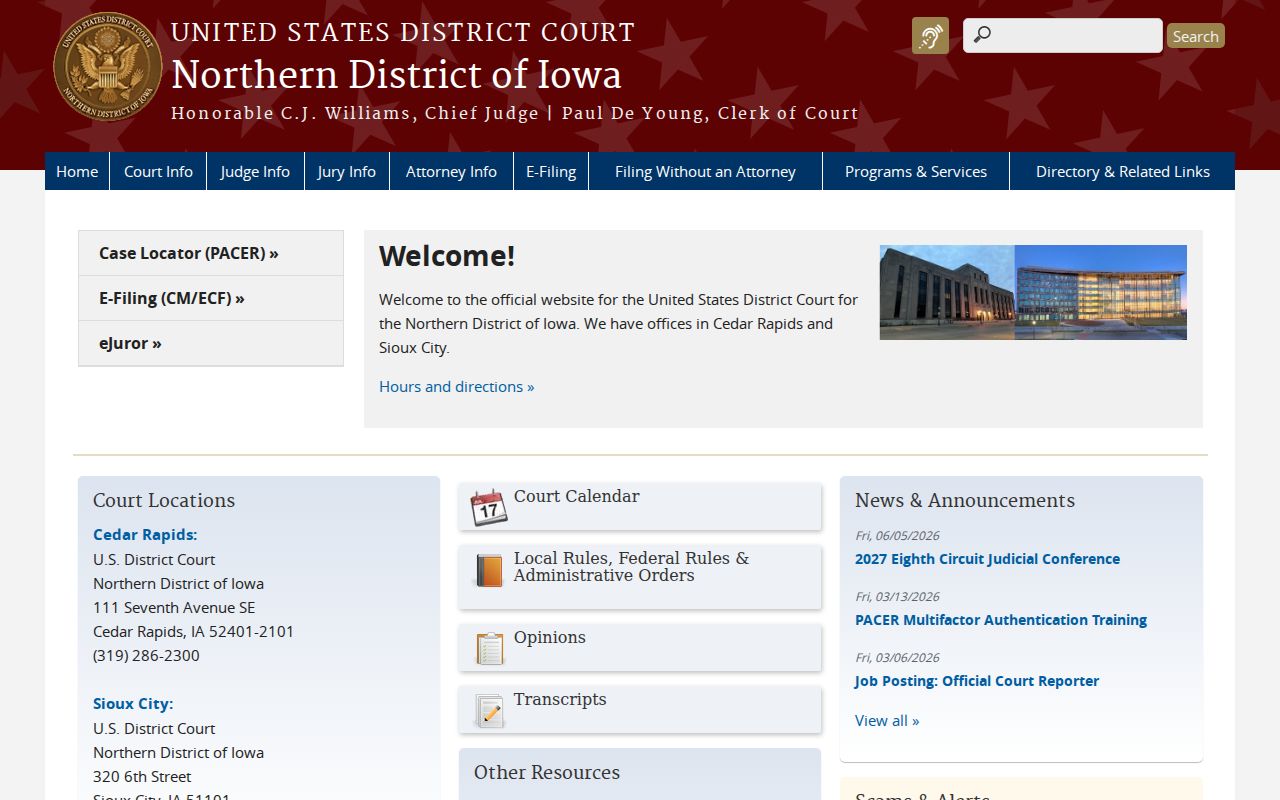
This federal channel should be used only when the matter was filed in federal court, not as a substitute for the Pocahontas County District Court docket.
The PACER service provides federal case search and document access.
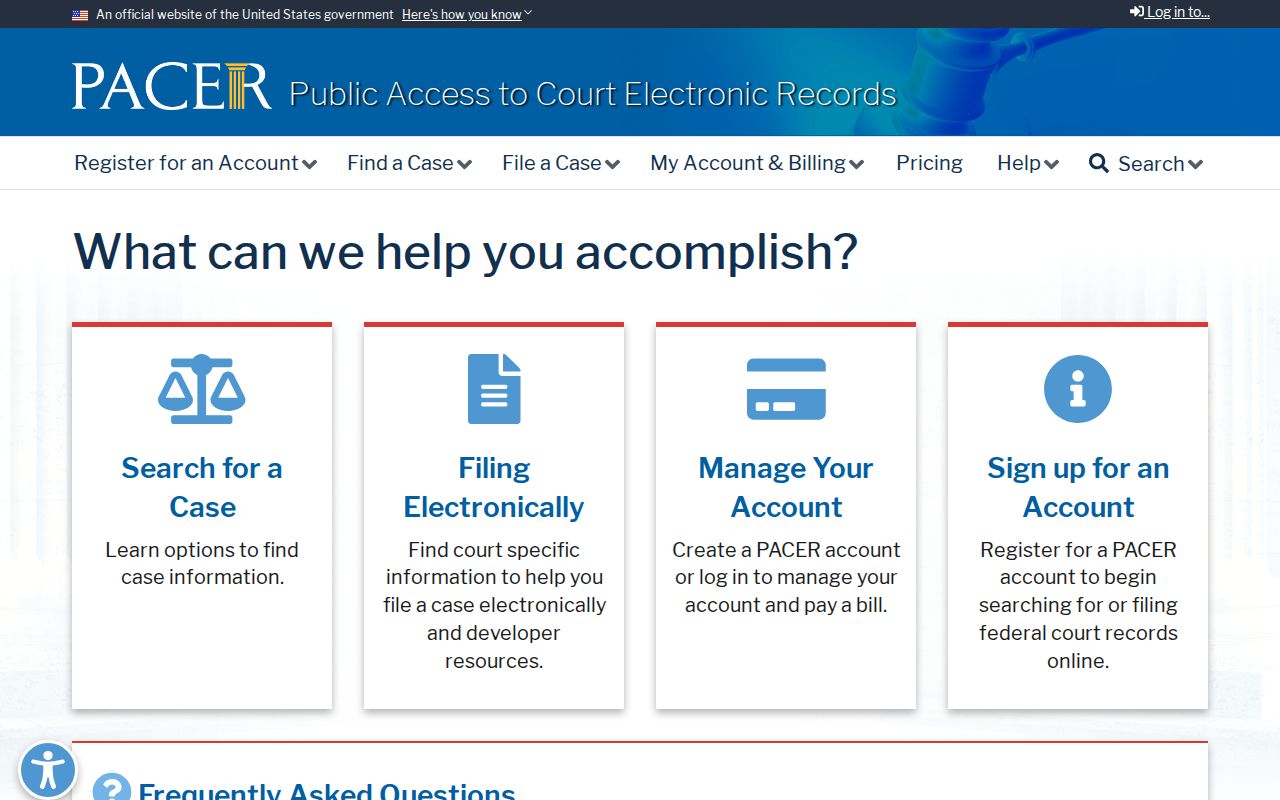
PACER registration and current usage charges apply, while sealed federal material still requires direction from the federal clerk.
Case Record Access & Restrictions
Most public Pocahontas County court records can be examined and copied, but the right is not unlimited. Confidential examples include unexecuted arrest or search warrants, sealed juvenile matters, presentence investigation reports, commitment cases, certain deferred-judgment docket material, and records sealed by court order. Online redaction can also make a screen view narrower than the public portion available through the clerk.
Iowa Courts Online describes public terminal documents as free to view at the courthouse where filed. Judicial guidance gives a general copy figure of 50 cents per page plus possible supervision or special-service cost, but readers should confirm the current charge with the Pocahontas clerk before ordering. Under the Iowa Open Records Law, agencies may release public portions while protecting exempt content. Court access also follows judicial rules, so the clerk's process controls the court file.
When a public case is missing, give the clerk the name, approximate filing date, case type, and any citation or case number. Ask whether the file predates the electronic index, uses a different name format, or is subject to a confidentiality rule. For a public document, state whether inspection, an ordinary copy, or a certified copy is needed. Those are different services and may carry different costs.